
Why “Powering Through” is Killing Your Career ROI
Stress Management for Professionals: Why "Powering Through" Is Killing Your Development
In the corporate world, we've been sold a lie, a dangerous one at that. Here's how it goes (btw, see if you can recognise it, cause it takes various forms):
"The most excellent professionals are the ones who suppress their emotions the most." In mathematical lingo, it means emotional intelligence and professional excellence are inversely proportional.
Here are a few examples of how this has played out: You believe that the "strong" leader is the one who remains calm, even nonchalant, despite losing a $2M contract a couple of minutes ago, unmoved by organisational restructuring, and silent, or the modern term, stoic, in the face of toxic office politics, right? If so, I'm not surprised.
Nowadays, we wear our ability to "power through" like a badge of honour, same way a soldier worthy of the title would never go to battle without his uniform and weapons.
But this is all wrong... painfully so.
And I say this because according to the foundational research in RISEUP: Your Career Reclaimed, this "Stoic Myth" is actually the primary cause of career plateaus and burnout in executives. The professionals who believe they are managing stress by suppressing it are, in reality, building the exact conditions that stall professional development and erode long-term career growth.
The reason is because when you suppress stress, you aren't practising stress management for professionals, you are simply storing it. And that backfires catastrophically in the office. Kinda like forcing water through a hose with no outlet... it never ends well, and we all know that.
But for all this to make sense, I need to explain something that's related, and that's…
The Physiology of Career Stress: What Poor Stress Management for Professionals Actually Costs
You see, to understand why "powering through" fails, we have to look at the "Source Code" of the human brain. Look, your brain is not a single, unified processor. It is a collection of systems often at odds with each other.
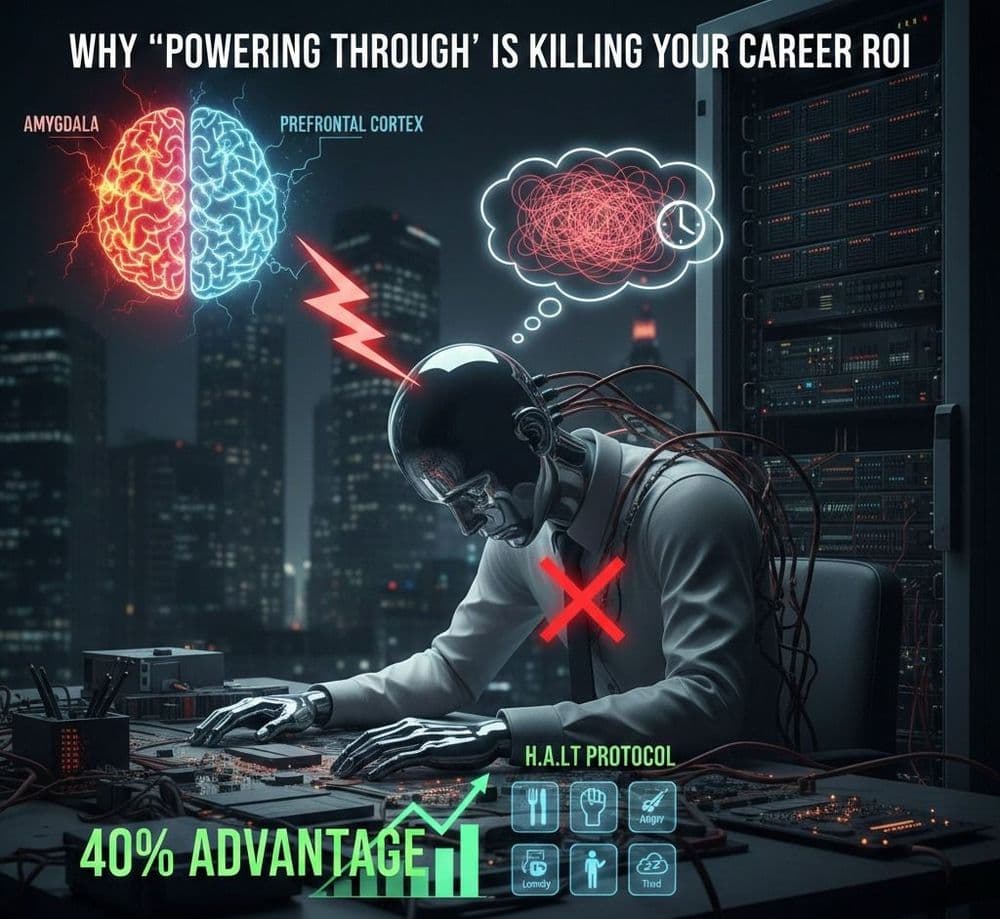
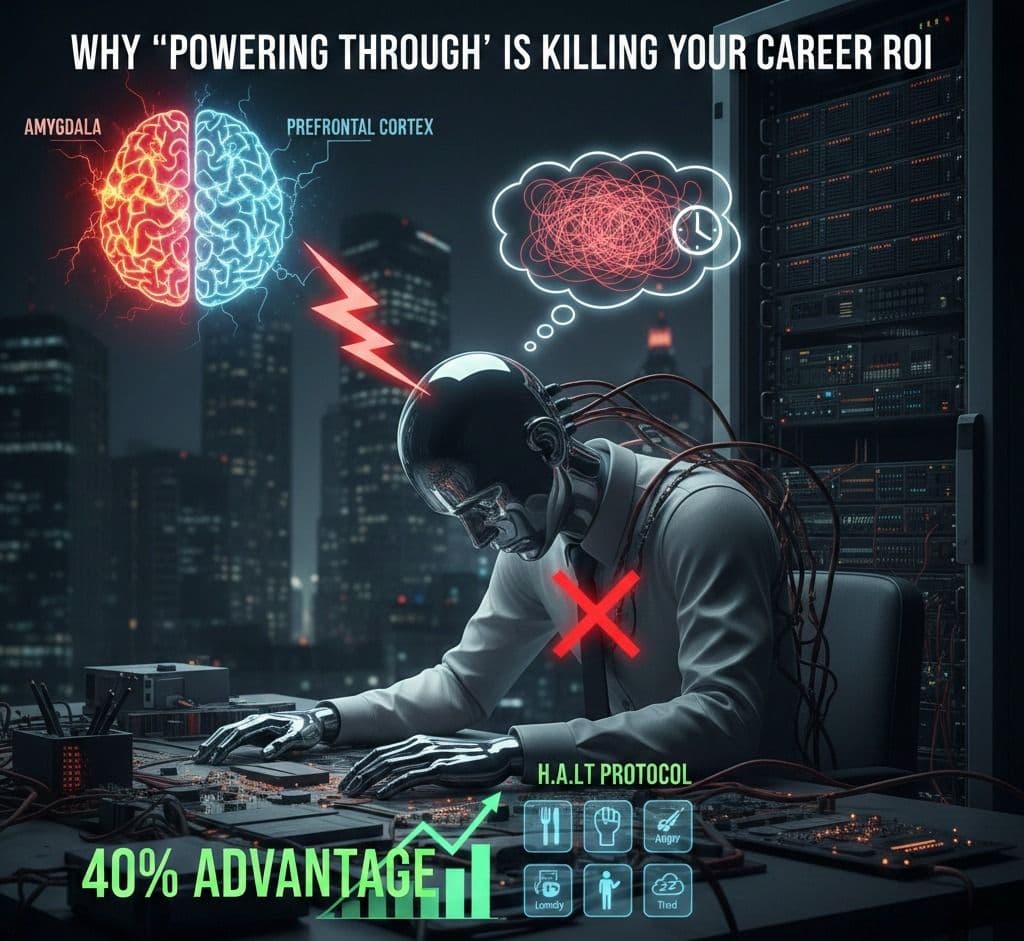
Here's why that fact matters for your professional development: when you're faced with a stressful situation at work, like harsh feedback (what we know as destructive criticism) or a sudden change in a project, your Amygdala (the brain's threat detector) fires first. It activates your body's stress response, triggering the release of stress hormones including cortisol. That cortisol then disrupts the functioning of your Prefrontal Cortex (PFC), the part of your brain responsible for good decision-making, empathy, and strategic planning. When cortisol levels spike, PFC function drops, making it impossible to think clearly.
Now, is it any surprise that in moments of impulse we make decisions we look back on and think: "what was I thinking when I did that???" At RISEUP, we'd love you to do the exact opposite, think clearly about your next move.
Well, don't fret tho, cause there's a solution, and it is…
The Discovery That Changes Everything: Affect Labeling and Professional Growth
If you read Chapter 4 of RISEUP: Your Career Reclaimed, we introduced a protocol that feels almost too simple to be effective: Affect Labeling.
Simply put, Affect Labeling is assigning a specific word to your feelings at every point in time. So that means you go from "Oh my gosh, I'm stressed…" to "I'm feeling overlooked because my department's budget was cut without anyone asking for my input."
Now, why does this matter? Well, brain imaging studies (such as those led by Matthew Lieberman at UCLA) show that when a professional attaches a specific word to an emotion, activity in the amygdala decreases, and activity in the right ventrolateral prefrontal cortex increases.
Alright, I'm pretty sure that last sentence got you lost. Believe me, the first time I read it, I was lost as well, lol. So, to put it simply, researchers like Matt discovered that naming the feeling puts you back in charge of your emotions. And which professional doesn't want to be in control of his or her emotions? Any one? Okay, moving on…
The 40% Advantage: Why Emotional Recovery Is a Professional Development Strategy
The data cited in our flagship book is clear: professionals who utilise Affect Labeling recover from the physiological effects of stress 40% faster than those who attempt to "push through," "stay composed," or be "stoic" about it (however you choose to call it, it doesn't matter, the facts remain the same.)
Think about it for a moment. In a standard 10-hour corporate day, the "push through" professional might spend 4 hours in a reactive, sub-optimal state following a morning crisis. On the other hand, the "RISEUP" professional, using the 40% Rule, is back to peak performance in less than 2.5 hours.
Over time, that recovery gap compounds... by a vast magnitude.
And this is because if you recover faster, you make better decisions. And it goes without saying that better decisions lead to better results, which leads to more responsibility, stronger career progression, and a higher salary. Kinda like a virtuous loop that just gets better with time.
Speaking of getting better, here's a framework that helps you do just that.
The HALT Protocol: A Science-Backed Stress Management System for Professionals
At RISEUP, we believe you shouldn't have to rely on willpower to be resilient. After all, willpower is anything but reliable. A system, on the other hand, is completely reliable. And in case you're not aware, this ain't new info. James Clear told the whole world this with his New York Times bestseller, Atomic Habits.
Picking up from where James left off, here's the stress management system you need: H.A.L.T. Check, one of the foundational "Circuit Breakers" we teach on our platform. Here's what it looks like:
H — Hungry
Is your glucose low, negatively affecting your PFC's ability to regulate? Decision-making quality drops measurably when blood glucose is depleted. Before escalating a tense situation or sending a reactive email, check whether you have eaten. It sounds comically simple, until you realise how often this is the root of your emotional states.
A — Angry
Are you reacting to a perceived threat to your status or autonomy? Anger in the workplace is almost always a signal that the amygdala has kicked the Prefrontal Cortex out of the driver's seat. Naming it, "I'm feeling dismissed because my recommendation was ignored without explanation," is Affect Labeling in real time, and it is what returns the PFC to the driver's seat.
L — Lonely
Are you operating in a vacuum without a support system or mentor? Look, isolation amplifies every professional stressor. The professionals who navigate high-pressure periods most effectively are almost never doing it alone. They have a peer circle, a mentor, or a community that provides perspective and accountability. Loneliness at work is a career development risk that rarely gets named as one.
T — Tired
Is physical exhaustion preventing you from accessing your strategic brain? Sleep deprivation has a well-documented effect on PFC function. A tired brain defaults to reactive, habit-based thinking, exactly the opposite of what professional growth and leadership development require.
By running the HALT diagnostic, you are engaging in Affect Labeling and moving the problem from a "feeling" to a "data point" that can be solved. Now, that's the difference between reacting and responding.
From Science to Career Growth: Building the Virtuous Loop
This is where the Virtuous Loop comes into play. Understanding the science behind emotional resilience is step one. Applying it through a structured system, Affect Labeling, the HALT Protocol, and the recovery habits that support both, is step two.
So, if you find yourself constantly "powering through," only for your career to plateau and your energy tank to empty, it's time to start using a new system. One built on how your brain actually works, not on the myth of the emotionally invincible professional.
For a practical framework on how to build these habits into a full career plan, our guide on career growth and professional development planning in 2026 covers the step-by-step structure that makes sustainable performance possible. And if you want to understand the daily learning habits that compound every skill in this article over time, our piece on how to become a learning machine for long-term professional development is ideal for you.
Keep reading
More on Burnout at Work: Spot It, Prevent It, Recover
- How to Avoid Burnout at Work When the Rules Nobody Gave You Are Running Your CareerResilience without reflection just helps you tolerate a broken system longer.
- The Productivity Lie: Why “Doing More” Is the Fastest Way to Burn OutStop confusing motion with progress. Master the art of doing less, better.
- Energy, Not Hours: The Next Era of Sustainable PerformanceStop managing your calendar. Start managing your energy for peak longevity.
- Are You "Holding Your Breath" at Work?Decoding the Emotional Signals of Sustainable Performance.