
What to Do After Getting a Job: Three Uncomfortable Truths Before the Regret Math Catches Up

There is a strange imbalance at the center of modern professional life, and the surprising thing is no one is talking about it.
The infrastructure supporting job acquisition is extensive: it is a marketplace where people spend more than $30 Billion annually and includes resumes, LinkedIn optimization, interview preparation, salary negotiation guides, and an industry of career coaches focused on the hiring process. In contrast, knowing what to do after getting a job is where the real gap begins, and the support available is practically zero, existing only in fragmented parts within companies that are not structured to provide it.
This is the gap that determines whether the next thirty years of your professional life are something you built or something that happened to you.
Based on personal experience, fieldwork, and firsthand observation of thousands of careers, here are three observations about that gap. Granted, each observation is uncomfortable, but on the flip side, they are actionable and worth noting.
1. What to Do After Getting a Job: The Finish Line Problem Nobody Warns You About
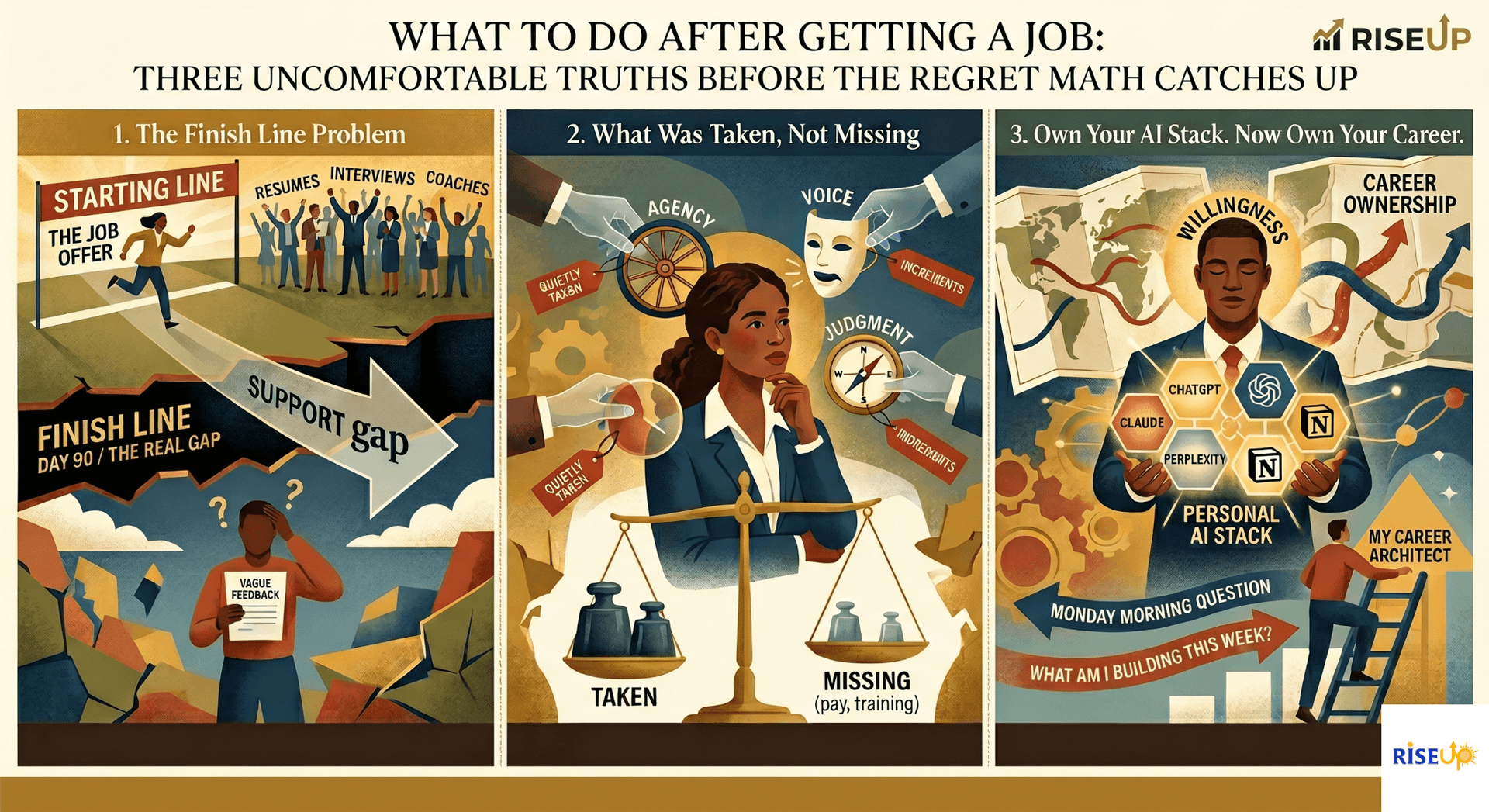
Think about the help available to someone trying to get a job. Resume tools, interview coaches, behavioral question banks, mock interviews, salary calculators, LinkedIn optimization, and cover letter generators. Basically, an entire industry of consultants who will package you for the market.
Now think about the help available to that same person on day 90, when their manager has just delivered the first piece of vague, poorly worded feedback and they are not sure whether it is a warning sign or a routine comment.
The gap is mind-blowing because the system treats the offer letter as the finish line, but the professional treats it as the starting line. Turns out both parties use the word "career" but are pointing at completely different things.
Here is the test I sometimes ask people to run on themselves. Pick any moment in your professional life where something important was at stake. It could be a performance review, a promotion or the decision about whether to leave or stay. Now ask which part of your formal education or training actually prepared you for that specific moment.
For almost everyone, the honest answer is none of it. We were taught the subject matter of the work, but we weren't taught the work of having the work. The gap between those two things is where most careers either compound or quietly fall apart. For a closer look at why the most commonly used post-hire tool makes this worse rather than better, Career Development Tools for Employees: Why the Performance Review Isn't One is worth reading in full.
The corporate world used to cover some of this gap through long manager apprenticeships, mentorship programs, and the kind of slow tenure that gave a young professional time to observe and absorb. That world is mostly gone. Tenures have shortened, managers are overwhelmed, and mentorship is now self-organized… if it ever happens at all.
So the work of closing the distance falls on you, whether you signed up for it or not. Once you see that clearly, you can stop waiting and start paying attention to what is actually happening, writing down what works, and building your own development on the side.
Moving on…
2. People Leave Because of What Was Taken From Them, Not What Was Missing
Twenty years ago, I was trying to understand why some sales teams thrived while others quietly collapsed. I conducted research on salespeople's job satisfaction and organizational commitment, looking for a pattern that would predict who would walk and who would dig in.
The pattern I found shocked me. Let me explain.
See, I'd assumed people left when something was missing. Maybe insufficient pay, inadequate benefits, lack of training, etc. The standard list companies invest in when they want to improve retention. True, those things mattered (and they still do), but they were never the actual reason someone left… at least in most cases.
What appeared in interview after interview was a different word: TAKEN.
Agency had been taken — the ability to make a decision without three layers of approval. The trust that the person doing the job knew how to do it. Voice had been taken — the space to disagree in a meeting without being labeled difficult. The room to push back on a strategy that did not make sense. Room to grow had been taken — the honest answer to "what does my career look like inside this company?" is not a set of platitudes about high potential and bright futures.
And here's where it gets worse: these were never taken in a single moment. They were taken in small daily increments, by managers who did not realize what they were doing, in systems that quietly rewarded compliance over contribution. And the professional rarely noticed it in real time. They only saw the end result: the slow erosion of the reasons they had wanted the job in the first place.
The question is not "what is my company giving me?" It is "what is my company quietly taking from me, and have I started to notice?" For a deeper look at how this pattern plays out across a career, What is Career Development: The Invisible Tax names the cost most professionals never think to calculate.
If you have been in your role long enough to have an opinion about it, run the audit. List the things you brought into the job on day one that mattered to you.
Voice. Judgment. Willingness to disagree. Appetite for risk. Enthusiasm.
Then ask honestly which are still intact and which have vanished.
If two or three have been quietly taken from you, you are not at the point of leaving. You are at the point of noticing. Most professionals miss this moment because they are too busy executing the work to consider the conditions under which it is performed.
Now, onto the final point…
3. You Already Own Your AI Stack. Now Own Your Career.
Ten years ago, most professionals worked with whatever tools their company provided. The CRM the company licensed. The presentation software that the company paid for. The collaboration platform that the IT team approved.
Your tool stack was an extension of your employer.
That world is gone. Today, almost every working professional has a personal AI stack more powerful than what their company offers.
ChatGPT for thinking. Claude for writing. Perplexity for research. Notion for organizing.
Whatever combination works for you, paid for by you, portable across employers.
Yet no one is drawing the obvious conclusion from this.
The shift in tool ownership has not been matched by a shift in career ownership. Most professionals still defer to their employer on what their career should look like. They wait to be developed. They wait to be promoted. They wait for the manager to tell them which skills are next, which projects matter, and which paths are open. The mental model of the company-as-career-architect remains in place even though every other dependency in the relationship has shifted.
That deference has become a liability. The same logic that gave you your own AI tools applies to your own career. The information is available. The frameworks are available. The mentors, peers, and communities are available. You no longer need the company to define the path.
What you need is the willingness to build it yourself.
Most professionals find this uncomfortable because there is no template, no manager to assign the next step, and no quarterly review to confirm progress. The shift is from executing predefined tasks to determining what is worth doing. That means documenting what you are learning even when no one asks, forming opinions on your industry that go beyond your team, building relationships outside your company, and deciding what to develop next before your manager does.
None of this requires permission, quitting or bragging about it on LinkedIn. What it requires is a small shift in the question you ask yourself on Monday morning. The old question was: What does my company need from me this week? The new question is: What am I building this week that compounds for me, regardless of what happens with my company? That second question you just read… that's the entire game.
Where This Leaves You
For a while, the system around you has been quietly changing while the language we use to describe it has stayed the same. Most career advice still answers the question of how to get the job, when the harder and more important question is what happens for the next three decades after you do.
If one of the three observations made you uncomfortable while you were reading, take note of that. The career you have right now is the one most worth examining, not the one you wish you had, not the one you might build someday… the one you walked into on a Monday morning, the last time you started a new role.
Keep reading