
Career Development Tools for Employees: Why the Performance Review Isn't One
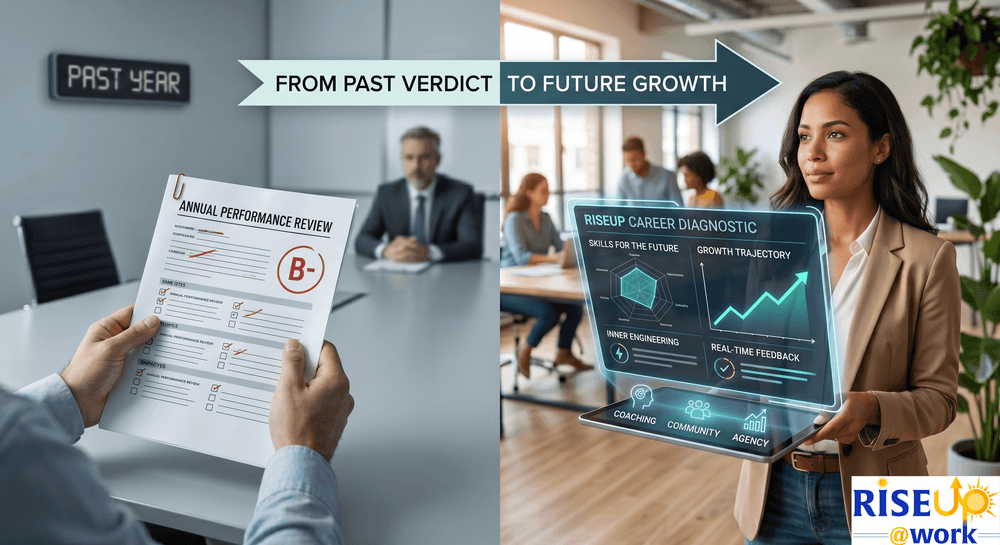
Every year, quarter (or if you are lucky, every month), someone sits across the table and grades your performance. It happens just like it was in school, you get your grades at the end of the school year, and that's it.
The problem is, almost everyone treats that document as the verdict on their career. And that's a mistake because the performance review was never designed to help you grow.
It was built to rank you, distribute pay, and, in the event of a dispute, protect the company. "Development" is a word stapled to the front so the exercise feels generous. Underneath, though, it's simply measurement, and measurement looks backward at output it can no longer change.
I spent 34 years in senior leadership across four countries, and 14 years coaching professionals through the arc of their careers. And in all this time, the pattern never broke. The performance review always measures the past year. But your career needs something the review was never designed to give i.e.a measure of what's happening now; while you can still do something about it.
If everything rings true, it begs the question…
Why Does the Review Still Persist?
You see, the review survives because it serves the institution, not the individual. Here's what I mean: Managers are rewarded for visible responsiveness and short-term output, not for building durable capability in their subordinates. As a result, their views of your performance over the last month outweigh the previous six. What's more, the halo effect lets one visible strength hide a real gap. And to put the nail in the proverbial coffin, the feedback arrives too late to change the outcome it describes, so the whole ritual becomes a source of anxiety rather than a tool for progress.
I'm not the only one who sees it this way though; the numbers do confirm it. Research consistently shows that about 23% of employees worldwide are engaged at work. And that's not surprising. After all, when you assess performance without accounting for unseen constraints that affect it, such as role clarity, resource access, and manager support, you are not measuring the person. What you're doing is measuring their environment and blaming them for being there.
But I'm not done, though, there's more…
The Part Nobody Tells You
The corporate contract that promised your employer would steward your growth is gone, the ladder that promised the climb into management was progress, but now leads to the layer where AI automates first. So once you strip away every external structure that once supported your career, just one asset remains standing –you. All this to say, the source of your value was never the title or the role; it was always you, and everything being stripped away has only made that painfully obvious.
That said, where do we go from here?
I probably sound like a broken record here, but I'll still say it: you need to pivot from anxiety to agency. Also, stop waiting for the performance review and instead learn to run your own diagnostic (if you don't know how to do this, read on, I'll show you how RISEUP@work can help you do that.) What's more, you still own the source of your value, which means you still have a say, and intentional diagnosis is how you exercise that say.
While we are at it, we might as well cover…
What Career Development Tools for Employees Actually Look Like
The diagnostic is the opposite of the performance review in every way: it looks forward instead of back, and it runs non-stop instead of once a year. That's not all, though; it examines the conditions that create the output, not just the output itself. The final difference, and in my own opinion, the most important one is this: it's built for the person, not the institution.
You see, instead of asking whether you hit your goals, the diagnostic asks what is actually blocking you from exceeding them. It identifies recurring friction in role clarity, decision speed, and access that annual performance reviews never capture. In the end, that shifts the focus from your failure to the system's friction and gives you a map to fix the environment rather than take the blame for it.
Now, onto the second difference: verdict to self-knowledge. As you might already know, the performance review tells you how you were seen. On the other hand, a diagnostic tells you who you are becoming, where your judgment is sharp and where it is lacking, what kind of work compounds your value and what erodes it. At RISEUP, we call this inner engineering, the deliberate development of the human underneath the work. What I just described is the half of an AI-era career that no agent can do for you, and as more time passes, it becomes the half that decides everything.
The final difference is from a single year to the full arc. Look, a career isn't supposed to be graded in twelve-month blocks; rather, it compounds across decades, through the three stages we call Launch, Foundation, and Dividend A diagnostic run non-stop across that arc protects what your career net worth is, which is the compounding total of your earning power, judgment, relationships, reputation, and optionality. Without the diagnostic, a career erodes, and the sad reality is that almost no one sees it happen in real time.
By the way, this advantage that comes from making better decisions consistently is what we call Return on Clarity, and it is the entire point of the diagnostic.
Since you understand this, let's look at…
The Hidden Tax, and the Market Underneath It
If you look closely, you'll see there's a cost to running the performance review, and organizations pay it in the form of churn. You see, people don't only leave bad managers; they abandon careers with no visible path forward. In fact, PwC's workforce research found that roughly 44% of workers are ready to change employers within a year, most of them seeking development they cannot find at their current organization. As if the current situation isn't bad enough already, the World Economic Forum projects that a large share of worker skills will be disrupted by 2030. Mind you, a backward-looking review cannot spot a skill gap before failure occurs for the exact reason that it only sees work already done.
Now, widen the lens to the market, and you'll see that there are lots of resources and platforms built to help people get hired, but there are almost no career development tools for employees built to help them grow once they've landed the role. And that's the opportunity RISEUP targets… the entire segment that the whole talent industry has left unserved because it is precisely where the diagnostic belongs, and it is what organizations that intend to keep their best people will be running in the next decade.
Speaking of RiseUp…
This Is the Career Development Tool We Are Building for Employees
The RISEUP Career Diagnostic is the productized version of everything above. It reads where a professional stands, where they are pointed, and what is blocking their growth, and it does so continuously rather than once a year. Then it pairs that diagnosis with AI tools, human coaching, and a peer community, and it accompanies the professional through all three stages of working life. In effect, it treats a career as a system to be diagnosed and fine-tuned, not a verdict to be delivered once a year with anxiety. This is why we firmly believe RiseUp sits at the front of one of the most underserved markets in the world of work.
At this point, one thing is obvious: If the tool you use for your career development is backward-looking, automatable, and built for the company rather than for you, then waiting for it is one of the most dangerous habits in your career.
More on How to Get Promoted at Work
- How to Get Promoted at Work: The Internal Advancement Strategy Nobody Talks AboutGet promoted fast with this internal strategy playbook. Learn the 5 key traits.
- How to Get Noticed at Work Before It's Too Late for Your CareerThe instinct to avoid managing up has killed more careers than bad work.
- How to Communicate Your Value at Work: Being Capable Is Not the Same as Being Understoodour work is excellent. The problem is nobody who matters knows that yet.
- The Internal Interview Test: Why Answering Well Isn't Enough to Get You PromotedThe most talented people don't always get promoted. The best-positioned ones do.