
Executive Resume Strategy: How to Quantify Your ROI
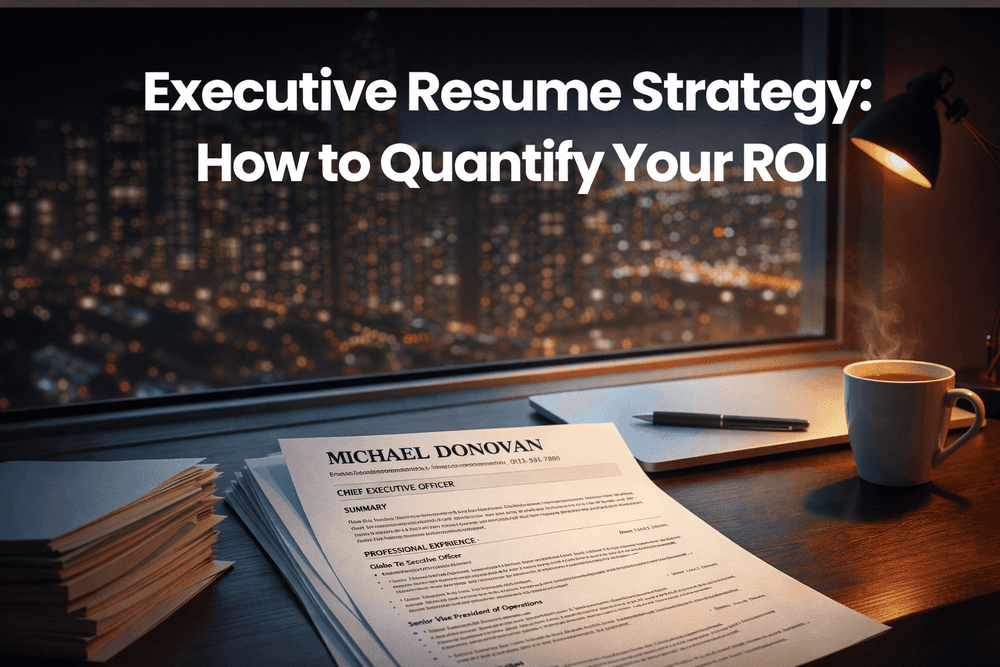
If you are treating your resume as a historical record of your past chores, you are already behind. In a high-velocity, AI-driven economy, your resume is not a biography; it is a Strategic Investment Prospectus.
Hiring managers at C-suite level don't buy solutions to problems unless those solutions come with a clear return. It has never been about experience alone. That's why to bridge the Navigation Gap, you must stop presenting yourself as an expense and start presenting yourself as an asset with a guaranteed return on investment (ROI).
To do so though, you'd have to understand something crucial, which I'll explain in the next section. Let's dive in, shall we?
Why Task-Based Language Fails When You Write an Executive Resume
You see, most professionals write their resumes in "Task Language." Here's what I mean, you'd see phrases like managed a team, oversaw budgets, attended meetings, yada, yada, yada…. And to a CFO or a Board of Directors, these are basics. In other words, you're just holding up your end of the bargain for getting paid.
To shift your standing, you must master Investment Language, which means a clear description of how your daily actions affect the business's bottom line. That's why instead of saying what you were responsible for, demonstrating what you achieved and, more importantly, what it was worth to the organisation always serves you best.
The difference in practice looks like this. "Managed a sales team of twelve" is task language. "Led a twelve-person sales team that grew quarterly revenue by 34% in two consecutive quarters by restructuring the outbound pipeline" is investment language. One tells a hiring manager what you did. The other tells them what you are worth.
Now, you know this. How can you do better? Well, that brings us to the next point...
How to Write an Executive Resume Using the CORE Framework
Here's something you should know: the foundation of a high-performance executive resume is the CORE Narrative, which is the system we developed at RISEUP for identifying and validating your professional impact. And no, it ain't just a series of bullet points. It's a verified proof (or badge, if you choose to call it that) of competence.
That's why when you're auditing your career history for your CV, every entry must meet the IMPACT Criteria:
Identify the Specific Problem
Was the situation Broken, Missing, or Stuck? Every strong CORE Story begins by naming the exact problem that existed before you arrived. Vague context produces vague proof. Specific context produces credibility.
Measure the Baseline Before You Arrived
Numbers matter here. What was the churn rate, the revenue figure, the error rate, the team size, or the timeline before your involvement? Without a baseline, your result has no frame of reference and hiring managers cannot calculate what you are actually worth.
Prove the Action You Took as the Strategic Architect
Not the team's action. Yours. What was the specific decision, initiative, or intervention you led? This is where most professionals undersell themselves by defaulting to "we" when the resume needs to reflect individual contribution and leadership.
Assess the Tangible Result
What changed as a direct result of your action? Be specific. Percentages, dollar amounts, timeframes, and headcount figures are all valid. "Improved customer satisfaction" is not a result. "Reduced customer complaints by 41% in 90 days by implementing a new escalation protocol" is a result.
Calculate the Compounding Value
Beyond the immediate result, what did that result make possible? A cost saving that freed up budget for a new hire. A process improvement that reduced onboarding time across the entire department. Compounding value shows strategic thinking, which is exactly what executive hiring managers are evaluating.
Translate Into the Language of the Decision-Maker
A CFO responds to revenue and cost language. A COO responds to efficiency and operational language. A Chief People Officer responds to retention and culture language. The same result can be framed multiple ways, and the most effective executive resume frames it in the language of the person reading it.
That said, let's move on to another hot button topic in the labour market...
AI-Powered Job Search: How to Optimise Your Executive Resume for ATS
Everyone knows that we are currently in the AI era of hiring. What everyone doesn't know is that your resume must navigate two different "GPS" systems before it ever reaches a human desk. First, the Applicant Tracking System (ATS) looks for structural keyword architecture. Second, AI-assisted recruiters look for contextual relevance to the job description.
Now, the secret isn't to "beat" the AI, but to partner with it. By using structured prompts and a clear narrative-first design, you can ensure your resume is optimised for technical screening without losing the authentic human voice that wins the interview.
In practical terms, this means using the exact phrases from the job description naturally throughout your resume, structuring your experience in clean, parseable sections rather than creative layouts that confuse ATS systems, and leading each role with a one-sentence investment language summary before the supporting CORE Stories. (Want to find out how to do so? Join RISEUP and you'd learn that in our Resume Builder course.)
Modern Career Infrastructure: Viewing Your Resume as a Career Development Asset
In conclusion, when you view your resume as a prospectus for investment, you begin to see your career differently. You stop looking for "jobs" and start looking for "investments." In effect, you move away from the "Interrogation Trap" and toward a consultative partnership, the mindset shift that changes not just how you interview but how you negotiate, how you position yourself for promotion, and how you build long-term career progression.
For a broader look at how this career development approach fits into a full professional growth plan, our guide on career growth and professional development planning in 2026 covers the complete framework.
Is your resume working as hard as you are, or is it a silent liability? It's time to stop hoping you get noticed and start making it impossible to ignore.