
How to Win the Job Interview Before It Even Starts
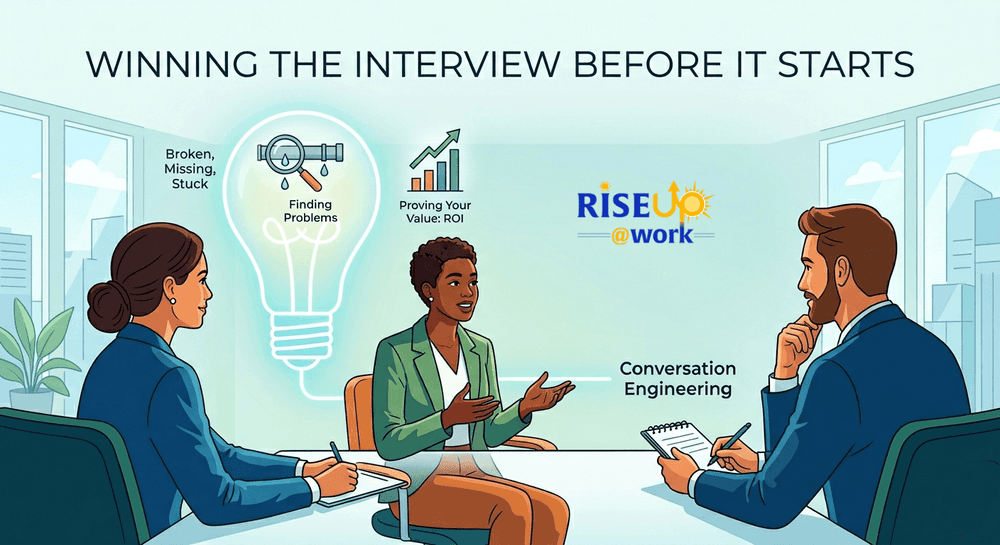
If you ever walk into an interview room expecting to just answer a list of questions, you've already lost. For a high-performer, an interview isn't a trial to prove your worth, it is a Consultative Investigation.
Give me a moment and I'll explain what I mean in simpler terms.
You see, most people fall into the "Interrogation Trap," where they sit passively, defending their resume like a defendant in court. But to bridge the gap between "looking for a job" and "building a career," you must act differently. After all, you aren't just looking for a job (technically, you are, but adopting that mindset wouldn't help you in the slightest,) you are there to diagnose and fix the company's leaks.
This guide walks you through exactly how to prepare for a job interview the right way, separating professionals who land roles aligned with their career goals from those who keep interviewing and wondering what went wrong.
That said, let's get to the interview proper.
The First 5 Minutes: How to Prepare for a Job Interview and Change the Energy of the Room
You see, the outcome of an interview is often decided in the first five minutes. This is your chance to turn things in your favour. Whilst other professionals are using this time for generic small talk about their hobbies (I'm not saying doing so is wrong, but in this context, it's not the smartest move), you should use it to signal that you're here to solve the company's bleeding neck problem.
This approach immediately alters the interviewer's view of you and your abilities. Suddenly, you're no longer a "line-item expense" anymore. You are a mission-critical partner, that team member they can't afford to lose (even if you aren't on the team …yet.)
In practice, knowing how to prepare for a job interview means arriving with a hypothesis already formed. Before the interview, research the company's recent performance, Glassdoor reviews, and industry trends. What is likely the biggest pain point for the team you are joining? Walk in with that question already half-answered. The first five minutes is where you validate it.
That shift, from passive candidate to diagnostic partner, is what begins to separate your interview from everyone else's. And it sets up everything that comes next.
Why You Should Stop Answering Questions and Start Finding Problems
Now, don't get me wrong. I'm not saying ignore your interviewer's questions in the quest to find problems. Doing that is a surefire way to ensure you DO NOT get the job, okay?
Now that's out of the way, come closer, let me tell you a top secret: companies don't actually hire people, they hire solutions to friction. Your primary job in the room is to find that friction. Before the technical questions (which you should by all means answer, lol) even begin, your goal is to understand three things.
What Is Broken? Which current process is failing the team? This could be a pipeline issue, a communication breakdown between departments, a product that is not converting, or a workflow that is costing the team hours every week. When you name a broken process specifically, you demonstrate that you have done your homework and that your career development has equipped you to think at a diagnostic level, not just an execution level.
What Is Missing? What skill or infrastructure is absent that is preventing growth? This is often where your specific background becomes the most relevant. The missing piece is your entry point. If you can name what is absent and then connect it to your experience, you have just answered the hiring manager's most important question before they even asked it.
What Is Stuck? Where is the bottleneck costing the organisation time or momentum? Identifying what is stuck shows strategic thinking. It tells the interviewer that you understand how organisations move and where they stall, which is exactly the kind of professional development that supports career progression into senior and leadership roles.
Once you have figured this out, every answer you give becomes a demonstration of how you can fix that specific problem. In effect, you're showing them what life would be like when they no longer have that problem on their plate.
Now, how do you prove that value? Well, that's what the CORE Stories method covered in the next section would show you.
Using CORE Stories to Prove Your Career Value (The ROI Method)
When the questions do come, don't offer generic "I'm a hard worker" type answers cause they're bland and forgettable. Just like a cooked chicken without any spicing. Instead, deploy CORE Stories, which is the perfect spice combination your career needs.
But first, what's a CORE Story?
A CORE Story is a framework designed to provide interview ROI (Return on Investment) almost immediately. And it follows a simple structure.
The Baseline
Where did the project or situation start? Set the scene with a specific number, a measurable problem, or a concrete context. "When I joined, the team was losing 30% of leads at the proposal stage" is a baseline. "I worked in sales" is not. The specificity is what makes the story credible and what anchors the interviewer's attention.
The Intervention
What did you specifically do to change it? Not what the team did. Not what happened. What you decided, initiated, or led. This is where professionals undersell themselves most consistently by defaulting to "we." The CORE Story requires "I." Owning your contribution clearly is not arrogance, it is the kind of professional self-awareness that reflects strong personal branding and career development at its best.
The Result
What was the measurable value you created for the company? Percentages, timelines, revenue figures, retention rates, cost savings. The result is the ROI the employer is calculating when they decide whether to hire you. With this structure, you're almost guaranteed to checkmate the king every single time. In other words, this framework helps you answer the most important concern on your employer's mind: "Will this person generate more value than they cost?"
For a closer look at how the CORE framework fits into a broader career growth strategy, our guide on career growth and professional development planning in 2026 covers the full structure.
Why AI Cannot Replace Your Real-World Career Development
Now, you may be wondering: what if AI can already do the things the employer wants? Of what value is my real-world experience?
Well, consider this.
In a world where AI can generate "perfect" interview answers, your human advantage lies in Navigation and Insight. AI can produce a polished response to "tell me about a time you led a team." It cannot walk into a room, read the energy, identify the unspoken friction, and build trust with a hiring manager in real time.
The professionals who will advance their career goals in 2026 are not the ones with the most optimised answers. They are the ones who can lead a conversation, diagnose complex organisational problems, and make a hiring manager feel, before the interview is over, that losing this candidate would be a mistake.
That diagnostic ability, combined with the CORE Stories framework, is what creates the kind of career progression that compounds over time. It is not a trick you use once. It is a professional skill you build deliberately. For a deeper look at how this mindset connects to long-term professional development, our guide on how to become a learning machine for career development covers the habits that make it stick.
Start Preparing for Job Interviews That Align With Your Career Goals
To wrap up, I'd love you to think about this: is your interview strategy designed for the future, or are you still relying on luck?
Either answer you arrive at, I think you should know what to do.
Keep reading