
How to Get Promoted at Work: The Internal Advancement Strategy Nobody Talks About
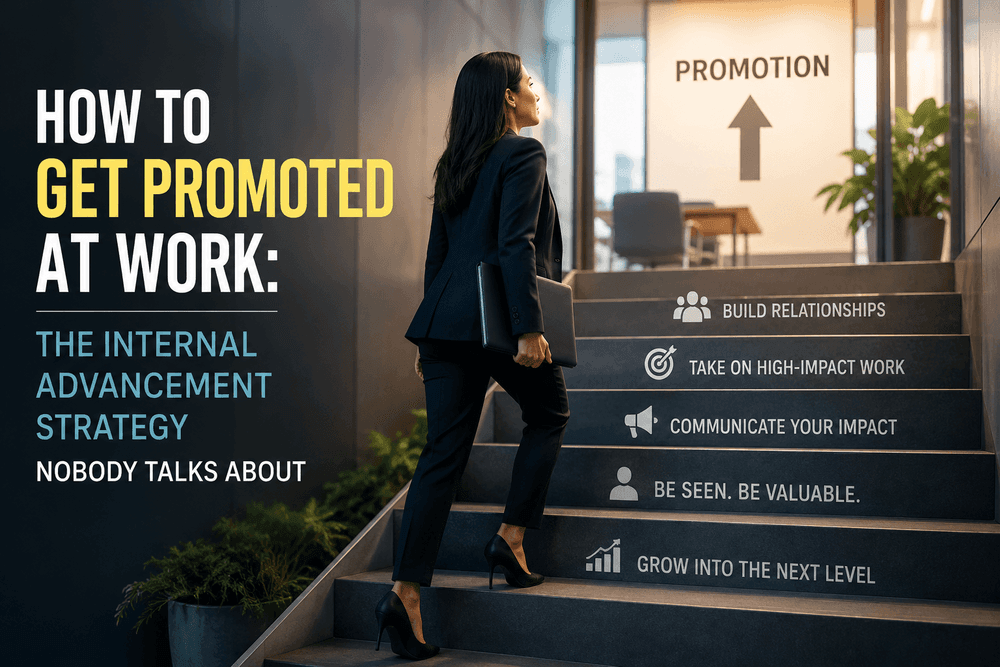
There is a moment most professionals hit somewhere in their first two years on the job. Here's what I mean: their work is pretty decent, but it's not just them who thinks so because their manager gives them good reviews. But they aren't making any progress. No promotion conversation going on, no expanded scope, just same old, same old… over and over again.
Well, in the RCL104 session, Dr. Deepak Bhootra, founder of RISEUP At Work, addressed this exact scenario and the topic, unsurprisingly, was Internal Advancement Strategy. In that session, he covered a lot. Why career growth stalls, what is actually blocking it, and the specific moves you need to make to get promoted at work without switching companies… that's just the tip of the iceberg covered in this session.
Let's dive into it, shall we? Starting with the fact that…
Performance Alone Won't Get You Promoted at Work
This is the wakeup call that everything else depends on. Don't worry, I'll explain.
You see, most professionals operate on the assumption that if they work hard and stay reliable, eventually someone will notice. Problem is… that's not how it works in the real world because according to Deepak: "Effort by itself is not going to be enough. You need to have a strategy to navigate the system inside." Mind you, these are his words not mine, so I think you're better off listening to someone who's seen it all.
Here's something you should know: organisations promote on the basis of five traits. Perceived readiness, Organisational fit, Business need, Trust, and how clearly leadership can read your potential for what comes next.
Now, notice what's missing from that list: the quality of the work itself. But don't get me wrong, this does not mean that the work doesn't matter. It means the work is the floor, not the ceiling. And since promotions are granted by an organisation's reading of your readiness for the next level, which by the way is based on someone's perception, then managing that perception is the job most people forget to do. So is it any surprise they don't get promoted?
That said, let's talk about…
Why You Are Stuck (And No, Your Work Isn't Responsible For This)
By default, when professional growth stalls, the instinct is to assume the work is not good enough. But in most cases, that is not the issue. Rather, the issue is more of a structural one. I'll let Dr. Deepak do the explaining here, starting with…
Low visibility:
Look, your work may be excellent, and your team knows what you contribute, but the people shaping advancement decisions have never actually seen it. In other words, the decision makers, the people whose opinions actually matter, do not.
Task language:
Here's the thing, most people describe their work in task terms. "I produced 50 reports." But that's not business language. Business language sounds more like this: "I produced 50 insights that leadership used to make decisions on whether to exit or acquire business X." The shift from what you did to what it changed matters… far more than most professionals realise.
Executor perception:
Being called "reliable" sounds like a compliment, and it is. But there is a nuance to it because in advancement conversations, it could quickly become a trap. When you are seen as a strong executor, you are being recognised for what you deliver today only, not for what you could do tomorrow. And that gap lives in perception, not in skill.
Undefined readiness:
Are you aware that wanting a promotion is not the same as knowing what promotion readiness actually looks like in your specific role? Because if you cannot define what the next level requires, you cannot demonstrate that you are there.
Now, we've seen the four things holding most professionals back. Let's see what can propel them forward.
The Four Internal Drivers That Actually Get You Promoted at Work
Once the problem is clear, the work becomes closing the gap. Here's how it's done.
Visibility:
Your work has to be understood, not just completed. Here's a simple test: can a decision maker two levels above you describe your impact in their own words, accurately? If the answer is no, you've got no visibility regardless of how strong the work is.
Alignment:
Your effort needs to connect clearly to business priorities because at times, brilliant professionals often deliver excellent work that sits just outside the strategy. And when that happens, "it will produce very little advancement." In other words, you need to know where your work lands inside the company's actual priorities, not adjacent to them.
Sponsorship:
This one is direct and that's because "every promotion of mine has happened because someone fought for me in a room that I was not in." Sponsorship is not mentorship. It is someone putting their credibility on the line for you in conversations you will never be part of. And if no senior person is willing to advocate for you when you are not present, advancement is going to be slow, no mincing words about that. So it's best you find those people deliberately… and as fast as possible.
Readiness signalling:
Start behaving one level above where you are today. In a recent coaching session, Dr. Deepak asked a professional who wanted a director title within six months to identify the behaviours directors around them were already demonstrating, then asked how many of those behaviours they were currently practising. The answer revealed the gap fast. If you are not showing the behaviours of the role you want, there is no evidence for anyone to promote you into it.
Now, we are down to the most interesting part of the session…
How to Have a Real Promotion Readiness Conversation
Most promotion conversations are weak because professionals ask the wrong question. The classic version goes like this: "What would it take for me to get promoted?"
The problem with this question is that it's open-ended enough for a manager to respond vaguely, then both of you nod, and in the end, nothing changes. On the other hand, a stronger approach targets specifics:
What does someone at the next level need to demonstrate? Where are you already operating at that level? Where are you still below it? What projects in the next six months would increase your manager's confidence in your readiness?
These questions force a real answer. They also shift the dynamic from asking for approval to jointly designing a path forward. And that change matters because you don't want to be waiting forever, you want to become someone who is actively designing the future of the role.
The One Move That Changes Your Career Development Trajectory
In conclusion, if there is a single takeaway from the session, it is this: translate your work from activity language into business language.
Take the three biggest things you delivered this quarter. Write them down the way you normally would. Then ask: what did it impact for the team, the customer, the decision, the risk? Then write that version instead.
That second version is what your manager will use to describe you in the room you are not in. It is what a sponsor will say when they advocate for you. It is how decision makers build a picture of your readiness. This isn't just office politics, it's how organisations function. And it applies whether you are working on your professional development goals for this year or building the foundation for the one after.
Because here is the reality that ties it all together: "Promotion isn't something that is earned in isolation. You have to do the work to deserve it, but it's interpreted from the work you do." When that sinks in, everything else starts to move faster.
Most importantly, don't miss the next RCL session happening on 26th May, 2026: RCL105 - Career Pivots Without Collapse
Keep reading
More on How to Get Promoted at Work
- How to Get Noticed at Work Before It's Too Late for Your CareerThe instinct to avoid managing up has killed more careers than bad work.
- How to Communicate Your Value at Work: Being Capable Is Not the Same as Being Understoodour work is excellent. The problem is nobody who matters knows that yet.
- What Makes a Good Employee Today Is Not What You ThinkWhat used to signal excellence now signals nothing. Here's what does.
- Career Development Tools for Employees: Why the Performance Review Isn't OneWhy the annual review fails employees and what actually works.